


Policy & Regulatory Recommendations

Strengthening the safety and resilience of e-bus operations requires a clear understanding of existing regulatory and policy gaps affecting e-bus safety, while outlining practical and actionable pathways to address these gaps. It underscores the need to enhance disaster resilience, operational safety, and regulatory oversight by systematically integrating resilience considerations across legal frameworks, institutional arrangements, technical standards, and contractual mechanisms. The section further emphasizes that the development of a safe and resilient e-bus ecosystem depends on coordinated action and effective oversight by relevant central and state authorities.

The following sections outline the key thematic areas under which gaps have been assessed and corresponding strategic recommendations have been presented.
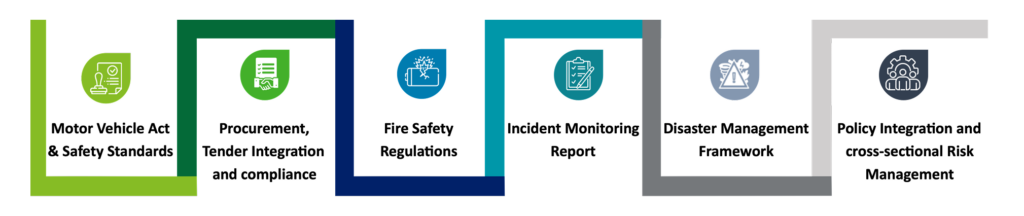
Motor Vehicle Rules and EV-Specific Safety Standards

This theme examines the adequacy of existing motor vehicle rules and technical standards in addressing EV-specific safety risks in e-buses, particularly those related to battery systems, environmental exposure, and post-crash scenarios. It highlights gaps in current CMVR provisions and underscores the need for strengthened EV-specific safety standards, testing, and certification to ensure uniform, nationally consistent safety outcomes.

Stakeholder

Existing Regulatory Context

Recommended Regulatory Strengthening

National: Ministry of Road Transport & Highways (MoRTH); Standard Formulation Agencies

(Automotive Industry Standards Committee, Bureau of Indian Standards); Testing & Certification Agencies (ARAI, ICAT, CIRT, etc.)

The Central Motor Vehicle Act (CMVA) and Central Motor Vehicle Rules (CMVR) currently provide limited guidance on battery insulation and enclosure safety, flood-resilient vehicle design, and post-crash battery monitoring and handling.

Revisions to CMVR may include:

  • EV-specific safety provisions related to battery management systems, electric shock prevention, and post-crash fire protection.
  • Environmental protection standards such as higher Ingress Protection (e.g., IP68 protection level) ratings for batteries and high voltage electrical components in e-buses operating in flood-prone or coastal regions.
  • Strengthened vehicle certification processes through accredited testing agencies to ensure OEM compliance with evolving safety technologies and global standards.

Relevance and Institutional Benefits:

  • Provides clear, nationally consistent safety benchmarks for battery insulation, ingress protection, and post-crash safety, reducing ambiguity in vehicle approvals.
  • Strengthens the ability of the STUs to make informed, safety-led procurement and fleet induction decisions, rather than relying solely on OEM-defined specifications.
  • Enhances regulatory oversight through accredited testing and certification processes, ensuring OEM compliance with evolving safety technologies and global standards.
  • Improves disaster resilience and operational continuity of e-bus fleets by minimizing safety incidents and service disruptions.
  • Reinforces the role of transport authorities as safety regulators while safeguarding public investments in electric mobility infrastructure.

This theme focuses on the role of procurement processes and concession agreements in shaping safety outcomes for e-bus operations, highlighting gaps in the systematic inclusion of EV-specific safety requirements, emergency preparedness, and compliance mechanisms. It identifies opportunities to strengthen tenders and contracts by embedding enforceable safety obligations, audit frameworks, and performance-linked accountability across operators, OEMs, and depot infrastructure.

Stakeholder

Existing Regulatory Context

Recommended Regulatory Strengthening

National: Convergence Energy Services Limited (CESL)

Many e-bus tenders and concession agreements currently exhibit the following gaps:

  • Absence of Standardized safety clauses specific to e-bus operations.
  • No mandatory depot safety certification or periodic safety audits.
  • Limited flexibility for public bus agencies in specifying safety-related design parameters.

Safety requirements may be systematically embedded in all e-bus tenders and agreements through:

  • Mandatory EV Specific safety protocols and training requirements
  • Explicit incorporation of third-party inspections and periodic audits as part of concession documents.
  • Clearly defined penalties and key performance indicators (KPIs) related to safety and emergency preparedness.
  • Mandatory submission of battery health data by bidders for all e-buses supplied, enabling continuous monitoring of battery performance.

State/ Urban: Public Bus Agencies (STU/ MTU/ SPV)

Many e-bus tenders and compliance agreements currently exhibit the following gaps:

  • Lack of Structured SOPs which can be applied for disaster and emergency situations.
  • Limited availability of trained and accredited safety inspection personnel
  • Inconsistent application of EV-specific Depot Safety Parameters
  • Limited disclosure of safety performance and compliance status

Safety requirements may be systematically embedded in all e-bus tenders and agreements through:

  • Require operators & public bus agencies to develop, implement, and periodically update SOPs for EV-related emergencies, aligned with state disaster management frameworks
  • Assessment of the existing and establish mechanism for the training, accreditation or empanelment of safety professionals.

Compliance with standardized national-level e-bus depot design guidelines is recommended, including but not limited to:

  • Fire separation zones and segregation of charging bays
  • Integrated fire detection, alarm and suppression systems
  • Adequate access for fire tender and emergency vehicles
  • Flood-resilient depot layouts, raised plinths were required, and effective drainage systems.
  • Installation of clear and standardized safety signage across depot premises.
  • Mandatory safety certification prior to commissioning and periodic re-certification at defined intervals to strengthen compliance and operational oversight.

A structured system for periodic audits and monitoring is recommended:

  • Recommend three to six monthly safety audits by STA/ third party/ fire department for fit to operate certification.
  • Recommend safety audits every 2 years through statutory bodies like fire department, DDMA or other designated authorities
  • Maintain public registry of audit scores and compliance history.

Relevance and Institutional Benefits:

  • Embeds safety and disaster preparedness as enforceable contractual obligations rather than advisory provisions.
  • Strengthens the ability of STUs to regulate operators and OEMs through clear safety-linked performance metrics.
  • Reduces operational and financial risks by ensuring early identification of safety gaps in vehicles, depots, and charging infrastructure.
  • Improves accountability and transparency through third-party audits and public disclosure of compliance performance.
  • Builds long-term institutional capacity through training, accreditation, and standardized safety oversight mechanisms.

This theme focuses on strengthening fire safety regulations for e-buses by examining the adequacy of existing fire safety frameworks in addressing EV specific risks. It highlights critical regulatory gaps related to lithium-ion batteries, high-voltage systems, and charging infrastructure, and outlines areas where targeted updates to state and national regulations can significantly enhance operational safety and regulatory clarity.

Stakeholder

Existing Regulatory Context

Recommended Regulatory Strengthening

National: Ministry of Housing & Urban Affairs (MoHUA)

  • Existing MoHUA guidelines do not sufficiently account for EV-specific fire risks, resulting in fragmented adoption of safety practices and reliance on conventional fire norms that may be inadequate for electric bus operations.
  • Current MoHUA manuals (e.g., Manual for Planning, Design and Implementation of City Bus Depots) often focus on traditional, retrofitted diesel layouts rather than specialized, purpose-built electric hubs.
  • Ministry of Housing & Urban Affairs (MoHUA) should recommend the integration of EV-specific fire safety requirements into urban bus depot planning norms, urban transport guidelines and centrally supported schemes such as PM E-Bus Sewa scheme, making compliance with prescribed fire safety standards a condition for financial assistance and project approvals. State Government may also consider linking financial incentives, viability gap funding, or infrastructure support for e-bus depots to compliance with prescribed EV-specific fire safety standards, thereby reinforcing uniform adoption at the city and operator level.
  • MoHUA should also recommend compliance with these fire safety provisions in their guidelines for all e-bus depots developed or operated by Urban Local Bodies (ULBs) and Special Purpose Vehicles (SPVs).

State: State Fire Services /Directorate of Fire & Emergency Services

  • Most State Fire Acts do not explicitly recognize fire risks associated with Lithium-ion battery systems, High-voltage power electronics and Electric bus charging infrastructure.
  • Fire safety inspections for depots and workshops are generally conducted using norms applicable to conventional fuel-based vehicles, which may be inadequate for addressing EV-specific risks.
  • At present, many e-bus depots and charging facilities commence operations without a structured, EV-specific fire safety certification process. The absence of standardized “fit to operate” criteria increase operational risk.
  • It is recommended that all e-bus depots and associated infrastructure obtain fire safety clearance including a fit to operate or No objection certificate from the State/ City Fire Department prior to start of operations based on the verification of the:
    • Depot Layout
    • Separation spacing of Charging Bays
    • Thermal Monitoring systems
    • Emergency Access compliance besides any other aspects
  • State Fire Acts and associated rules may be updated to:
    • Recognize Class E fire risks linked to high-voltage battery systems and power electronics in e-buses.
    • Recommend fire suppression systems suitable for lithium-ion and other battery chemistries in buses, depots, and charging areas.
  • Mandate inclusion of thermal runaway, battery management system failure, and short-circuit risks in fire risk assessments.

Relevance and Institutional Benefits:

  • Clear and EV-specific fire safety provisions reduce ambiguity in approvals and inspections, improve preparedness of fire services and minimize asset damage, service disruption, and post-incident liability.
  • Such certification mechanisms provide STUs with assurance of operational readiness, standardized benchmarks for depot approval and improved accountability of operators and concessionaires.

This theme focuses on strengthening incident reporting and safety monitoring mechanisms for e-bus operations by addressing the absence of a centralized, national-level system for capturing and analyzing e-mobility related safety incidents. It highlights the need for institutionalized data collection, post-incident learning, and cross-state knowledge sharing to support evidence-based safety improvements in the urban transport sector.

Stakeholder

Existing Regulatory Context

Recommended Regulatory Strengthening

National: Urban Transport Department, MoHUA

No centralized system for systematically capturing and analyzing safety incidents related to electric mobility hazards.

  • A national-level incident reporting and monitoring repository, led by the Urban Transport Department under the Ministry of Housing and Urban Affairs (MoHUA), is recommended to capture information under the following heads:
    • Centralised Safety Log: It is suggested to maintain a centralized log capturing safety-related incidents, near misses, and hazards both within the depot and from global experiences along with context and corrective actions taken.
    • Post-Incident Assessment: Team may consider reviewing post-incident outcomes to identify any changes in industry practices, technological upgrades, or handling procedures that could enhance future preparedness.
    • Relevance Mapping: It is recommended to assess the relevance of each incident and its corrective actions to the organization’s operations, helping identify applicable lessons and improvement opportunities.
    • Continuous Updating: Safety registers may be updated regularly with new incidents, response measures, and learnings to foster ongoing improvement and institutional learning.
  • Other line ministries may provide the necessary input to support the achievement of periodic updating of the same.

Relevance and Institutional Benefits:

  • Enable consistent reporting of e-bus safety incidents.
  • Facilitate cross-state learning and knowledge dissemination.
  • Support evidence-based improvements in safety standards and operational practices.

This theme examines the integration of electric bus related risks within existing disaster management frameworks, highlighting gaps in sector specific preparedness, inter-agency coordination, and emergency response protocols. It identifies opportunities to strengthen disaster management plans by explicitly addressing e-bus operational hazards and clarifying institutional roles across transport, fire, and disaster response agencies.

Stakeholder

Existing Regulatory Context

Recommended Regulatory Strengthening

State: State Disaster Management Authority (SDMA), Public Bus Agencies (State Transport Department / State Transport Undertaking)

Under the Disaster Management Act, State Governments are mandated to prepare and implement State Disaster Management Plans in alignment with the National Plan, and State Disaster Management Authorities (SDMAs) are required to ensure that all line departments, including State Transport Departments, prepare sector-specific disaster management plans. However, existing State Transport Department disaster management plans largely lack provisions and standard operating procedures for public bus transport and e-bus–specific risks, limiting the effectiveness of preparedness and emergency response to electric mobility–related hazards.

  • It is recommended that the Disaster Management Plans for State Transport Departments be updated to explicitly address disaster scenarios related to public transport systems, with specific provisions for e-bus operations, including:
    • Identification and assessment of e-bus–specific risks, such as battery fires, thermal runaway, water ingress in depots, and post-accident thermal incidents.
    • Development and inclusion of Standard Operating Procedures (SOPs) for prevention, preparedness, response, and recovery related to e-bus thermal and electrical hazards.
    • Clear roles and responsibilities of transport authorities, depot operators, fire services, and emergency responders in managing e-bus–related incidents.
  • E-bus depot infrastructure could be recognized as critical urban infrastructure within disaster planning frameworks.

Urban: Urban Local Bodies (ULBs) / Municipal Corporations/ Special Purpose vehicles/ Municipal Transport Undertakings etc.

  • Every municipal corporation in India has mandate to develop city-level disaster management plan that involves critical infrastructure services, including public transportation. However, there is a recognized gap in comprehensively addressing e-bus related hazards and moving beyond treating public transport solely as a relief resource (i.e., just for evacuation) to integrate it into active, risk-aware, disaster-resilient operational plans that has specific operational SOPs for new technologies like e-buses.
  • Lack of inter-agency coordination between transport departments, STUs, fire services, SDMA/ DDMA/ UDMA and other relevant agencies during emergencies.
  • It is recommended to collaboratively develop an emergency response plan involving all the relevant authorities such as Transport Departments, Fire Services, SDMA/DDMA/UDMA, STUs/SPVs, Municipal Corporations, DISCOMs and OEMs.
  • Clear delineation of roles, escalation procedures, and communication protocols is essential to reduce response time and operational confusion.

Relevance and Institutional Benefits:

  • Clear delineation of roles, escalation procedures, and communication protocols is essential to reduce response time and operational confusion.

This theme focuses on strengthening policy alignment and cross-sectoral risk management for electric bus infrastructure by integrating disaster resilience and safety considerations across transport, electric mobility, and disaster management frameworks. It highlights gaps arising from limited coordination among line ministries and disaster management authorities and identifies opportunities to embed safety and resilience requirements as conditionalities within national and state electric mobility schemes.

Stakeholder

Existing Regulatory Context

Recommended Regulatory Strengthening

National: Ministry of Road Transport & Highways (MoRTH), Ministry of Heavy Industries (MHI), Ministry of Housing & Urban Affairs (MoHUA)

Absence of explicit resilience and safety compliance requirements within various national-level electric mobility and e-bus schemes, resulting in inconsistent consideration of disaster preparedness and operational safety.

Disaster resilience and safety compliance may be integrated as conditional requirements under:

  • FAME II
  • PM E-DRIVE
  • PM E-BUS SEVA
  • National Electric Mobility Mission


State/ Urban: State Disaster Management Authorities (SDMAs) / District Disaster Management Authorities (DDMAs), Public Bus Agencies (State Transport Department/ State Transport Undertaking)

  • Limited involvement of disaster management authorities in developing or applying safety rating and risk assessment frameworks for e-bus depots, covering natural, technological, and human-induced hazards.
  • State-level electric mobility and e-bus schemes often lack clearly defined resilience and safety compliance provisions, leading to uneven incorporation of disaster preparedness and operational safety measures.
  • A safety rating system for e-bus depots may be adopted by STUs or Disaster Management Authorities, based on parameters such as:
    • Structural fire safety
    • Disaster Preparedness
    • Environmental Clearance
    • Digital Monitoring systems
    • Only depots meeting predefined safety thresholds may be issued occupation certificates
  • Disaster resilience and safety compliance may be integrated as conditional requirements within state electric mobility schemes and EV policies.

Relevance and Institutional Benefits:

  • Integrates disaster management authorities into the safety governance of e-bus depots, ensuring systematic assessment and safety rating framework for depots, for various natural, technological, and human-induced hazards.
  • Encourages proactive risk reduction by incentivizing depot operators and STUs to invest in disaster preparedness and safety upgrades.
  • Aligns safety and resilience outcomes with national and state electric mobility schemes, ensuring public funds are directed toward compliant and risk-prepared infrastructure.
  • Supports long-term operational continuity and asset protection by embedding resilience criteria into policy incentives and funding eligibility.